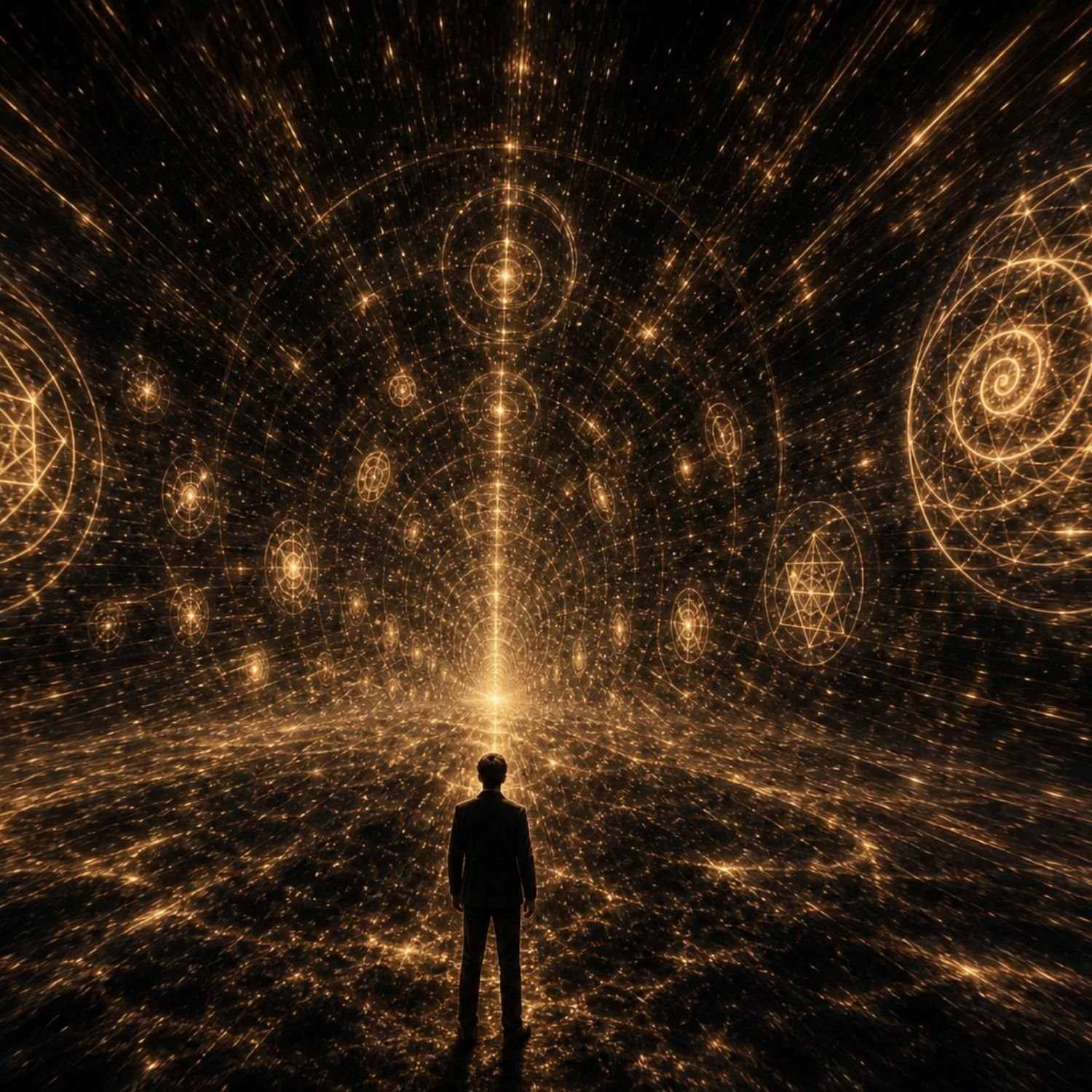
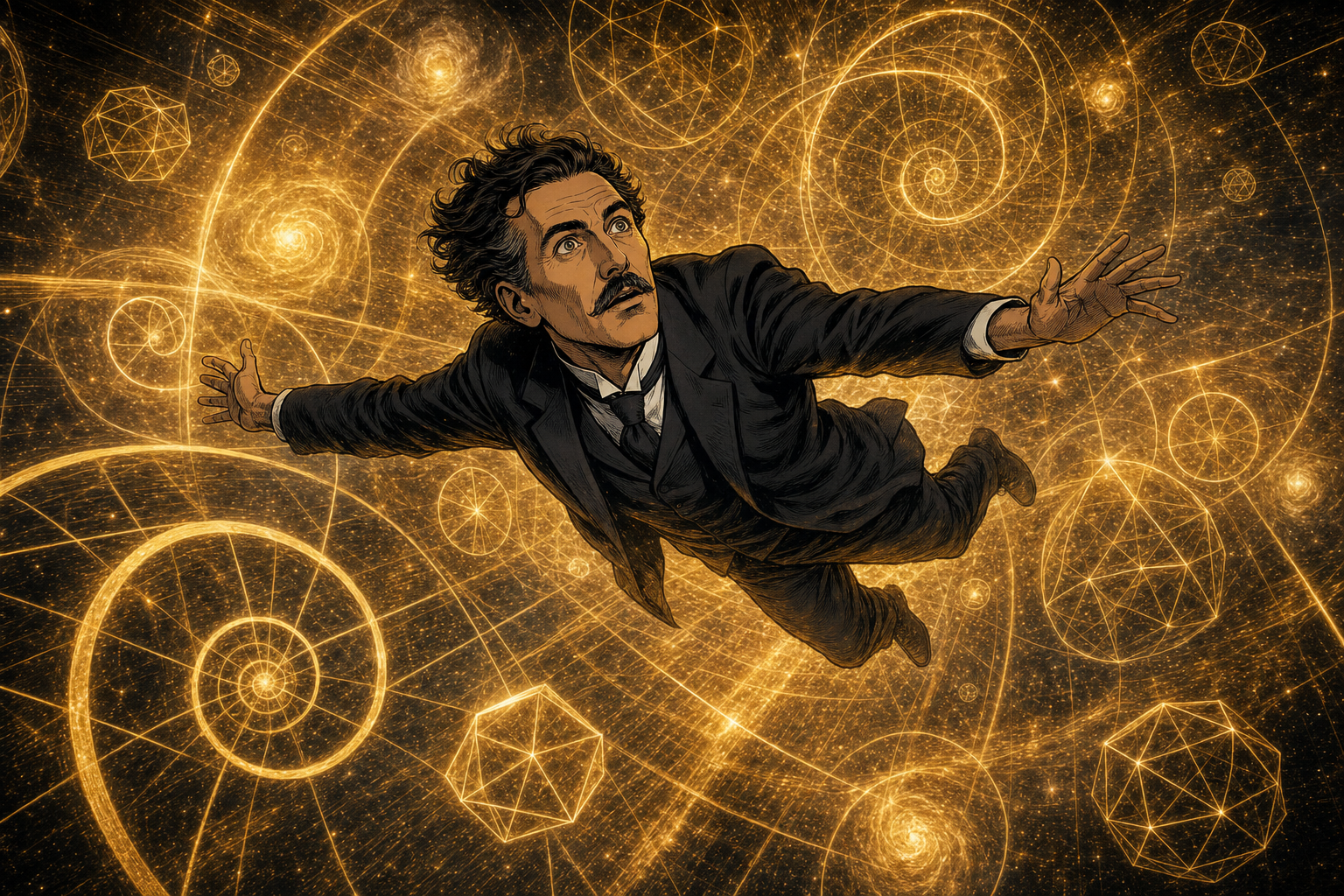
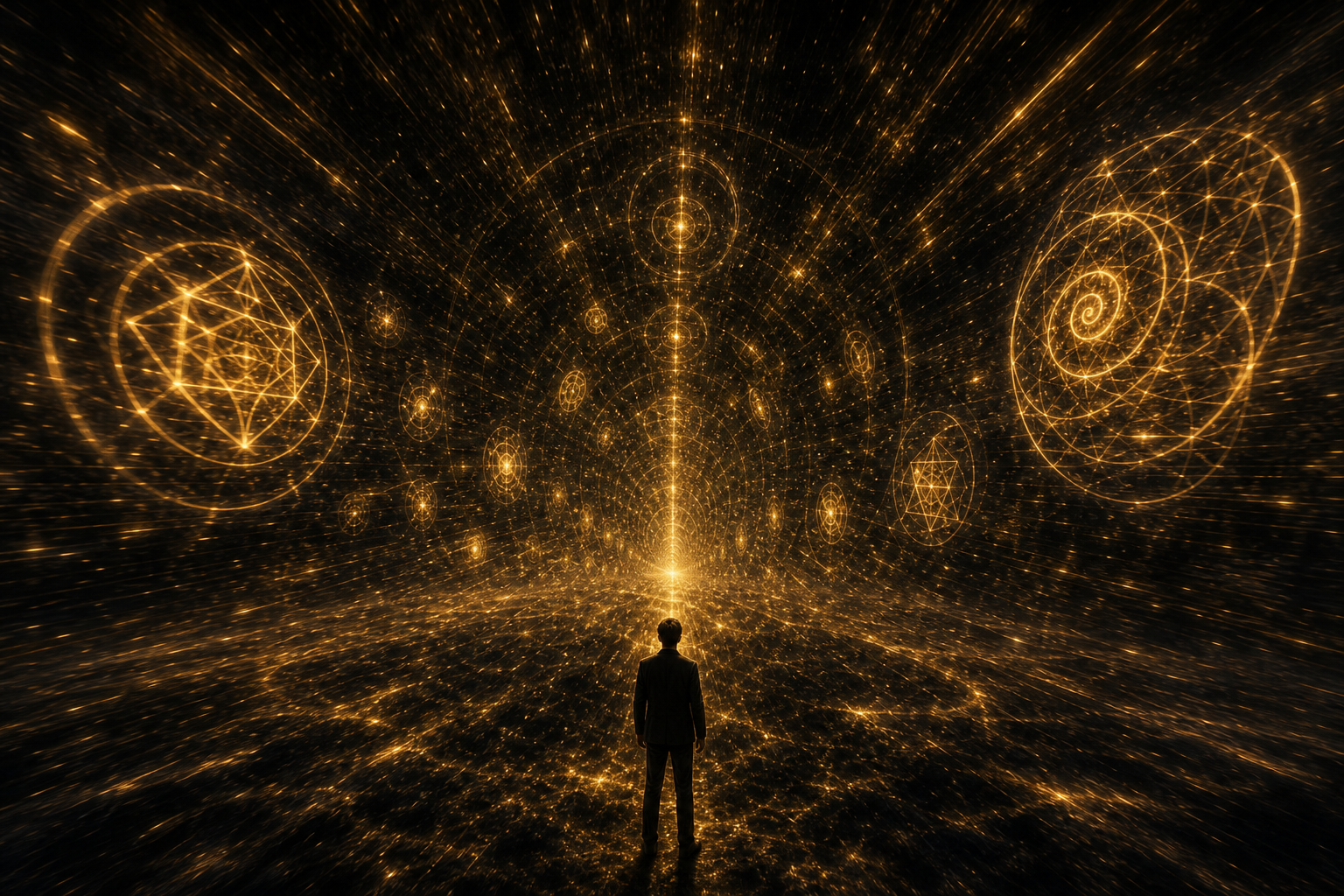
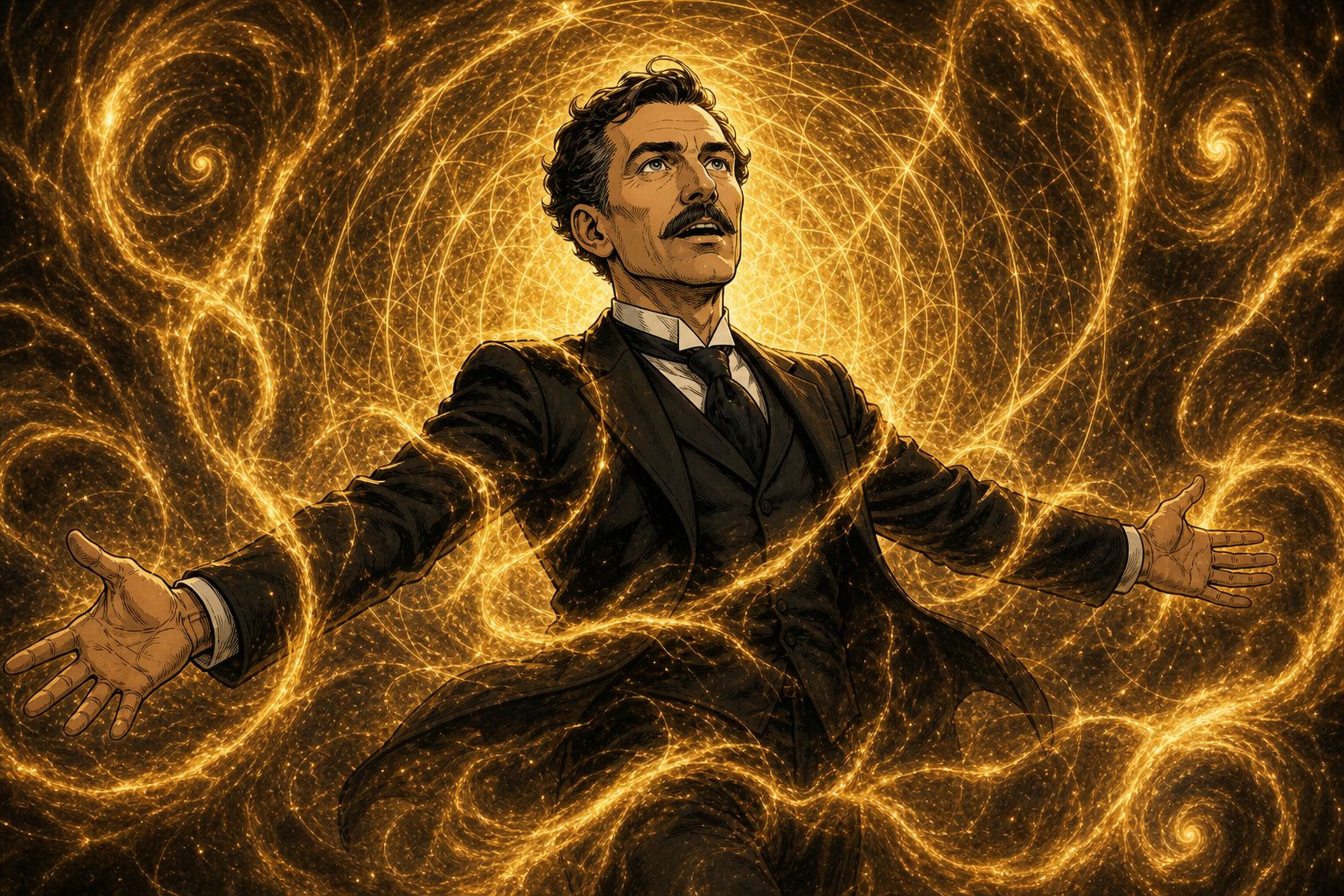
The Upwelling · An EP by Hopskotia · Atlyn Music
A Mini Opera in Three Movements
In 1921, a man fell into a coma and returned with the architecture of the universe. No one believed him. Except one.
In the spring of 1921, Walter Russell — painter, sculptor, architect, musician, and one of the most quietly extraordinary polymaths of his century — experienced something that collapsed the boundary between genius and revelation. He fell into what can only be described as an illuminated coma. For thirty-nine days, he did not fully inhabit this world.
"I was shown the universe as a whole — its structure, its music, its motion. The secrets of creation itself, compressed into my consciousness like light into a prism."
— Walter Russell, on his 39-day illumination, 1921What he brought back was staggering: a complete cosmological framework connecting consciousness to matter, light to thought, energy to form — the Universal One. A vision of reality in which consciousness is not the product of matter, but its source. Pages of diagrams, equations, and philosophical mappings that anticipated quantum field theory by decades.
He sent his manuscript to one hundred of the most renowned minds in the world. They laughed. The scientific establishment of 1921 had no framework to receive what Russell was offering. All but one dismissed him entirely. That one was Nikola Tesla — and in Tesla's recognition began one of history's most consequential and most private conversations. Two men who had each, in their own way, touched something the world was not yet prepared to hold.
Today, Russell's ideas are quietly finding their way into the emerging edges of consciousness research, unified field theory, and the philosophy of mind. A century after his descent, the world is finally becoming ready to hear what he brought back. This EP is his monument.
Walter is not a playlist. It is a single unfolding event — a descent, a reckoning, and a return — designed to be experienced beginning to end, without interruption. Twenty minutes from now, you will have traveled somewhere. You will have learned things and felt things. You will want to know more.
Each of the three movements has its own emotional center, its own sonic weight, its own place in the arc. Separated, they are powerful songs. Together, they are a ritual with a beginning, a cost, and a resolution. The journey earns its ending. The ending reframes everything before it.
Much of Hopskotia's music — and the Walter EP in particular — is architected with the neurodivergent and neurospicy mind at its core. Not as a gimmick, but as a philosophy. Frequent pattern changes, polyrhythmic arrangements, mixed time signatures, and unexpected dynamic shifts keep the listener's mind present by design. There is no autopilot here.
The music holds its own contract: the moment attention begins to drift, the floor shifts. A time signature breaks. The silence becomes a wall. A chorus returns with more weight than it carried before. You are pulled back in. This is not accidental — it is the architecture of the descent itself, built to hold you inside the experience for every one of its twenty minutes.
Eight minutes. The longest and most demanding movement. This is the full experience of Walter Russell's descent — not described, not illustrated, but felt. You are not watching him fall. You are inside his nervous system as it happens.
The music moves in waves: crushing progressive metal surges give way to moments of harmonic quiet — brief atmospheric pockets where the data settles — before the next ring of descent pulls you back under. Each chorus is a depth marker. A new layer of cosmic knowledge being received. "I can see the source of everything" carries different weight the fourth time than the first.
The outro — "I Wake. I Write. I Remember." — is the surface breaking. Eight minutes of descent resolved in six words.
Drop-D · 4/4 shifting to 7/8 · Cavernous organic reverb · Dynamic range from silence to crushing intensity · Polyrhythmic architecture throughout
The energy has changed entirely. Where Movement I was a torrent, this is a stone in still water. Heavy. Deliberate. Every note carrying the weight of what Russell brought back from the void.
Russell has sent his manuscript to one hundred of the greatest minds of 1921. They have laughed. All but one. Nikola Tesla — the man who watched his own discoveries get stolen, weaponized, and buried — recognizes the truth for what it is. What follows is their private exchange: two visionaries, each scarred by the world's inability to receive them, making the hardest decision two men can make together.
Tesla counsels silence. Not from cowardice — from witness. Russell wrestles openly with the unbearable weight. His misery is not enough to risk humanity. They plant the seeds together. The narrator closes the loop in a whispered coda: Russell died in 1963, still waiting.
Slower tempo · Two distinct male voices in dialogue · Less hitting, more holding · The weight of knowledge as a physical thing
The energy returns. The pace builds. And then — a voice. Female. Ephemeral. Speaking before the first note arrives: "He thought he descended alone. He didn't. We were always there."
This is the moment the entire trilogy has been moving toward. Time collapses. The future reaches backward — through the same spiral Russell set in motion — to confirm what he could never know in his lifetime: that it worked. That the seeds found soil. That his silence was not surrender.
The chorus drives it home with an earworm that stays for days: WALTER — called by name across time, called home. By the final bars the listener realizes they haven't just heard a story. They've been inside a closed loop.
Progressive metal returning to energy · Catchy driving chorus · Triumphant but earned · A female voice opens what only the future can close
// Distributed via DistroKid · Published under Atlyn Music · BMI
The Upwelling is not a band in the conventional sense. It is a vessel — a sonic identity constructed specifically to carry the weight of Walter Russell's story through progressive metal, the only genre capable of holding both the architectural complexity this material demands and the emotional gravity it deserves.
Behind The Upwelling is Hopskotia — the artistic identity of Jon Sanchez, a multi-genre composer, lyricist, and producer operating under the Atlyn Music imprint. Hopskotia does not belong to a single sound. It belongs to the idea that the right vessel must be built for each message. Genre is an instrument, not a home.
The Walter EP draws from documented history, genuine philosophy, and the emerging consciousness movements reshaping how humanity understands the relationship between mind and matter. Walter Russell's illumination is not mythology. This EP is its first proper monument.
The music keeps its own contract with the restless mind: the moment you begin to drift, the floor shifts. Twenty minutes, fully present. That is the ask. That is the reward.
The Upwelling's sound was chosen for what it demands of its listener. Drop-D guitars, polyrhythmic drum architecture shifting between time signatures, cavernous organic reverb, and dynamic range that moves from whispered quiet to overwhelming intensity — this music does not ask to be played in the background. It asks to be descended into.
The Walter EP exists in multiple genre reinterpretations — R&B, country, blues, and beyond — all produced under the Hopskotia umbrella. Each is a different door into the same story. The Upwelling's progressive metal originals are the canonical statement.